Design and development of Quadcopter and Hexacopters for level 4 autonomy
Worked on designing robust guidance-navigation-control architecture for level 4 autonomous drones for precision agriculture in Indian private and government agriculture sectors. During my undergrad, as a GNC developer at General Aeronautics Pvt Ltd and research intern at Computational Intellegence Lab, Indian Institute of Science, my responsibilities were centered on designing Software-In-The-Loop (SITL) and Hardware-In-The-Loop (HITL) modules for integrating custom RGBD and LiDAR-based obstacle detection with local Artificial Potential Field (APF) and Dynamic Window Approach (DWA) based collision avoidance techniques, simulateneously tracking high-precision drone kinematics with GPS RTK, laser altimetry and RGBD based visual odometry.
Interfaced and tested obstacle avoidance and radar-based ground clearance algorithm on non-compatible CAN-BUS interface with the Pixhawk Orange Cube, RPI 4B & Jetson Nano. With the objective of Variable Rate Application (VRA) in agricultural field, the decision making ROS scripts were implemented for executing circular navigation around detected tree canopy and a zigzag AUTO mode maneuvering for every row crops. The detection mechanism was based on visually differentiating between a target and an obstacle that was impletmented by training a CNN-based Yolov6 object detection model for over 100,000+ images of local crops, trees and possible obstacles. Additionally, a custom MiDaS based depth estimation algorithm was developed over a low-budget monocular camera for establishing a cone of object detection along the heading!
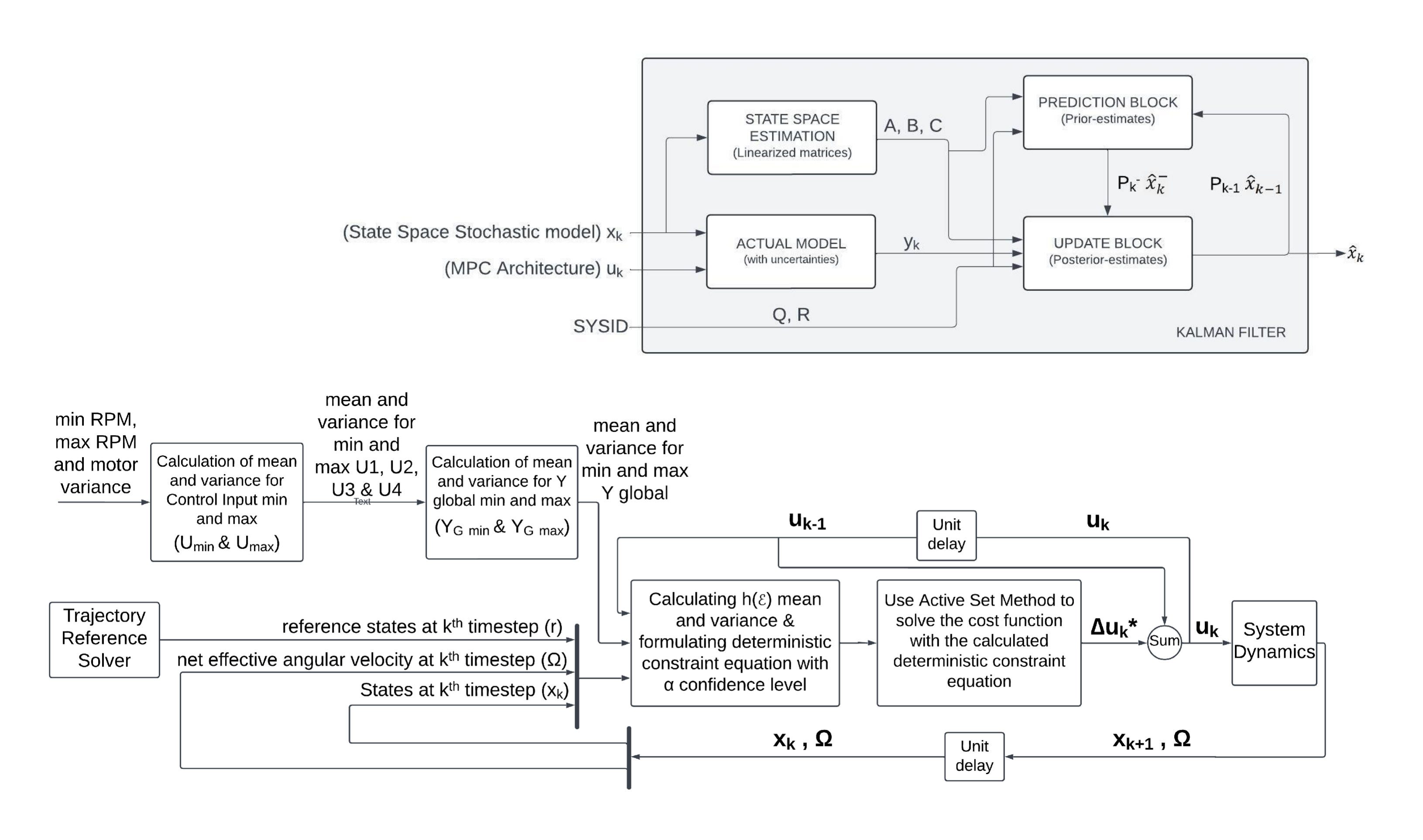
During this time, I was engaged in solving a very interesting problem on optimizing a reference tracking guidance-control architecture (Aryan, 2025) while considering the existance of quadcopter actuator’s non-negligible stochastic response to the control commands on top of well-studied measurement and process noise in the system.
On the left is monocular-depth camera interface with SITL quadcopter's ROS master script. Middle represents the APF algorithm overriding Ardupilot mission during every obstacle detection. The right plot shows the circular maneuvering around a suspected target for canopy spraying.
References
2025
Reference tracking of nonlinear airborne systems using stochastic MPC with disturbance observers and actuator chance constraint optimization
With ever-growing advancements in the field of aerospace technology, there are much wider opportunities and capabilities emerging as a constant demand in terms of speed and accuracy. One of the major segments for any airborne mission is its Guidance–Navigation–Control technique which becomes very crucial for the aspects of speed and accuracy, especially for defense or highly complex missions such as missile launches, space missions, airstrikes, and many more. A controller technique that is much more accurate than its traditional counterparts like Proportional–Integral–Derivative (PID) Control and Linear Quadratic Regulator (LQR), as well as constantly considering any instantaneous state measurement noises into account, is an irresistible demand and advantageous over other control techniques in use. A Model Predictive Controller (MPC) can smoothly handle actuator constraints, angle-of-attack constraints, and pitch-angle constraints which makes it more versatile and near perfect for practical nonlinear systems. However, for a real system in addition to the inefficiencies in sensor readings, an actuator control input itself acts as a randomly distributed variable. Therefore, a robust control scheme is designed to leverage stochastic MPC’s optimal bounded control while considering the stochastic nature of the system’s states as well as the system’s actuators. As an example, a real-world quadcopter is mathematically modeled in its nonlinear state space representation cascaded with a nonlinear discrete Kalman filter with distinct covariances for both state and control measurements, to estimate the distribution of the quadcopter states. This is followed by the nonlinear model predictive controller which acts based on the system’s guidance requirements on the perturbated states at each time instance for optimal reference path tracking. The MPC’s overall prediction horizon cost function forms an un-deterministic optimization problem due to the probabilistic distribution of actuator values that is tackled via chance-constraint programming, followed by a unique implementation of the active set method to solve the problem for the entire prediction horizon. The performance of the proposed stochastic MPC solver is compared with a tuned PID controller for a stochastic quadcopter model where the proposed controller’s capability of bounded and smooth inner-loop and outer-loop tracking is highlighted compared to the PID’s discrete, inefficient performance in the presence of stochastic actuation. The supporting simulations for the proposed reference tracking technique are implemented in MATLAB/Simulink tool with numerical as well as graphical analysis results.