The world of Quantum Mechanics (QM) might be one of the most mysterious regimes mankind has ever crossed paths with, that apparantly has been the mankind’s biggest tool for understanding the way the universe is today. Even though physicists throughout the years have constructed a concrete quantum framework on which theoretical and experimental data agree exceptionally, the core of this framework is probably the most arcane aspect of all. The wave function 𝜓, is probably the most controversial “object” in the world of metaphysics which is extensively exploited in the field of Quantum Mechanics (QM) and yet we have no idea what it truly represents. You might be familiar with the famous Schrodinger equation which basically speaks about the dynamics of a particle given its Hamiltonian and the solution to this equation is a unique wave function 𝜓. Even though the Born rule is applied to statistically analyze possible states of a particle when a measurement is to be taken, it is still very unintuitive to actually visualize what the 𝜓 truly plays as in the relevant mathematics involved. Above all the strangeness in Quantum Mechanics, the Schrodinger equation seems to very accurately predict the motion of a particle in a probabilistic manner but its use case seems to be limited the moment any measurement occurs on the relevant quantum system. This phenomenon is widely known as the wavefunction collapse and the scientific community has barely any conclusive lead on what could be the reason for such bizarre behavior of a particle or the so-called wavefunction associated. The early scientific community realized the intensity of this problem and subsequently today there exist a lot of philosophical interpretations of QM which have existed for almost the same time as the theory itself, around a century ago. It all started with a question of what the wave function of a particle means in reality. Is it a physical wave in some unperceivable higher-dimensional space or is it just a tool to get a piece of statistical information about the quantum states of the system being observed?
“As far as the laws of mathematics refer to reality, they are not certain; and as far as they are certain, they do not refer to reality.”
— Albert Einstein
When the solution for wavefunction collapse is given a thought, then it has to fit all the experimental results, and since we are aware of the existence of experiments like a double slit and delayed choice experiment, its trivial to imagine that a certain experiment on a quantum system would result in quantum states that are highly correlated to the experimental setup itself. In other words, every quantum experiment has a clear distinction between a measuring instrument/observer (macroscopic entity) and the quantum system being measured, where additionally, the quantum states are a superposition of experimental outcomes which are interestingly influenced by the experimental setup or the physical state of the observer, therefore it strongly implies that the Schrodinger equation suggests that the observer itself is in some kind of superposition of distinct states involved, which is conspicuously not true because if it were, we would have vivid visuals of the world without being drunk! In the well-accepted Copenhagen interpretation the solution for this is the Born rule which is a statistical view of observers’ superposition but again, according to the rule 𝜓 evolves deterministically as per Schrodinger equation but breaks down during a measurement event, which shows the inconsistency of Copenhagen interpretation.
The involvement of the experimental setups and the detector settings in manipulating the dynamics of the states of a quantum system is the branch called Operational Quantum Mechanics. With such a perspective, it is imperative to distinguish between the experimented quantum system and the experimental apparatus, a macroscopic entity. However very quickly one realizes that there are some core philosophical questions to be dealt with. What and when is there a solid partition between a quantum system and an observer so that one can classify components of an experiment to their respective roles? What is the role of consciousness during measurement and does the quantum system experience an observer’s presence?
Such partition between classical and quantum systems is known as Heisenberg’s cut and is only valid for interpretations where the collapse postulate holds like Copenhagen’s interpretation. Nevertheless, one thing is clear, in order for 𝜓 to represent some property of a quantum system abiding with some objective reality, it should involve experimental setup or the physical system acting as an input to the equation and somehow the resulting property should be invariant to any observer or consciousness within the universe. Note that this kind of thought process in the first place considers that 𝜓 describes something about the physical reality or at least insinuates some property of the physical system which is different from an epistemical approach on QM where it’s the observer and their knowledge about the system in question. There are few significant ontological models on QM that tries to cleverly eliminate the measurement collapse diligently avoiding non-causality and non-locality problems pointed out in the PBR theorem, as well as intuitively suggesting how the physical reality responds.
Many world theory is a concept derived from the Everrettian interpretation of Quantum Mechanics, first-ever appearing in the physicist Hugh Everett III’s thesis work. It is by far the most famous multi-universal concept replicated colossally in many sci-fi movies, TV shows, and even in a few fictional books. The basis for this interpretation lies in the idea that each state corresponding to a determined outcome for a quantum system in some experiment has relative states of other objects involved in this experimental system which either directly or indirectly interact with the quantum system. As a simple example, if we consider the system involves a quantum system, an apparatus that reads the outcome (an action of direct interaction) and an observer that refers to the environment that records these outcomes (an action of indirect interaction), then for a particular quantum state corresponding to a deterministic outcome, there is a relative superposition of states of environment capturing the result and relative states of observers observing the result from the environment. Moreover, there is no reason for an “objective” mechanism to exist that is biased to one fixed outcome when a measurement happens and so it is considered that all the combination of states of distinct entities involved, truly happens and could be only observed by an entity living outside the influence of quantum effects we experience in this universe (God’s-eye-view). If that’s the case, the collapsing nature of 𝜓 distribution is completely eliminated, since all the outcomes exist in its own different world. It is to be noted that this is an ontological model in the sense that 𝜓 distribution is treated as something that exists in reality and is equally present for as many worlds as the theory itself creates. And so even though an observer in its universe might not feel its superposition counterparts in another universe because theoretically with current cosmological models, an entity in one universe can’t sense or interact with other universe apart from their parent universe at all, it makes sense that an experiment done and followed in one universe would be perceived as a 𝜓 collapse giving one deterministic outcome because the true 𝜓 existing in some n-dimensional manifold was observed by someone in a 3-D universe and so where there can be a continuum of outcomes possible, the observer observes the projected 𝜓 in the observed 3-D universe as a determined outcome. But interestingly there is a cascading effect where a choice of observation or a unique interaction with a superposed quantum system in a universe will branch into infinitely many other possible worlds irrespective of whether the outcomes were discrete or continuous because the quantum state is not the only thing in superposition but the macroscopic entities, the observer and indeed the world itself is coherently in superposition.
When the quest for understanding Quantum Mechanics leads to plausible ontological theory on Infinite Universes, its acceptance solely depends on whether concepts like infinities and isolated macroscopic superposition worlds are rational with respect to the absolute reality, to which no possible experiment is yet capable of proving or disproving it. However, some critics have indeed pointed out a few minute flaws in the theory for example, What mechanism is responsible for the splitting of these worlds? If an object or a person does have copies of their own in other worlds, then what defines them as a “copy”? If each self has its own consciousness, being apt enough to make different choices, then how is a “true self” defined? These questions need to be addressed with revised philosophical definitions at a fundamental level and hence within the scientific community, there are a plethora of perspectives to it just based on its relative nature.
“When a physicist measures the spin of an electron, say in the north direction, the wave function of the electron and the measuring apparatus and the physicist are supposed, in the realist approach, to evolve deterministically, as dictated by the Schrödinger equation; but in consequence of their interaction during the measurement, the wave function becomes a superposition of two terms, in one of which the electron spin is positive and everyone in the world who looks into it thinks it is positive, and in the other the spin is negative and everyone thinks it is negative. Since in each term of the wave function everyone shares a belief that the spin has one definite sign, the existence of the superposition is undetectable. In effect the history of the world has split into two streams, uncorrelated with each other. … This is strange enough, but the fission of history would not only occur when someone measures a spin. In the realist approach the history of the world is endlessly splitting; it does so every time a macroscopic body becomes tied in with a choice of quantum states.”
— Steven Weinberg (The New York Review of Books)

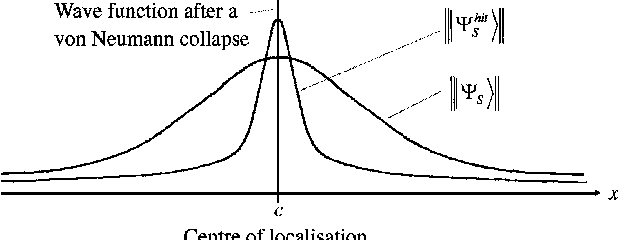
Ghirardi-Rimini-Weber (GRW) theory is a relatively recent collapse model which is based on a few explicit assumptions one of which suggests that the Schrodinger equation is incorrect. Rather it proposes a stochastic nonlinear dynamical mechanism that similar to the Schrodinger equation, describes the evolution of the wave function but additionally the act of state collapse or so-called “hit” is governed by the stochastic nature of evolution where the resulting localization is not measurement-induced but instead it is probabilistically evolving. With these assumptions, the progenitors of the theory not only address an alternative explanation for a spontaneous collapse but it provide a single dynamical equation that takes into account the quantum properties of fundamental particles, the classical properties of the macroscopic world, and the bridge connecting both regimes. The explanation for these probabilistic (random) collapses of the constituents of any physical system is explained through the collapse rate, i.e. number of collapses per unit time. Mathematically the act of measurement is represented as a localization operator operating on the wave function of the system and because the Gaussian functions are involved in the operator, intuitively a radius of the selected metric is established which acts as a boundary between a significant localization (macroscopic property) and an ineffective localization (microscopic property). As a standard, the metric is taken as the position and therefore the threshold radius is the length scale after which collapse rates are significantly high. In simpler terms, if the superposition of position states of a system is greater than this threshold radius, then the Gaussian part of the operator suppresses all the possible states except the closest one to the center of collapse, in short, localizes to a deterministic state, whereas if the superposition is within the threshold radius, none of the states are suppressed which is a direct consequence to a lesser collapse rate. According to GRW, the probability of an electron or proton to experience a collapse on average is around 10⁸ years, and hence practically one would never see a violation of Heisenberg’s uncertainty for these fundamental particles. Moreover, when such particles bunch together to form a relatively macroscopic object, the sheer number of particles outweighs the minute collapse rate value for individual particles, for example, if a particle collapses every 10¹⁸ seconds and the macroscopic object has around 10²⁶ such particles, then probabilistically, on average there would be 10⁸ collapses every second, which is sufficiently enough to perceive as a well-localized wave function in space. The concept indeed sounds reasonable and brings out a logical perspective of the transition from uncertain quantum properties to deterministic classical properties, however, GRW-like collapse theories carry some ontological problems. Tails problem is one of the well-known problems to such a theory which points out the spreading nature of wavefunction to infinity in all dimensions due to the Schrodinger dynamics and if that’s what happens then even though for a sufficiently macroscopic entity, the wavefunction would still have a non-zero value extending to infinity, just like a tail stretching to infinity. to infinity. This leads to a reasonable question of how can we interpret these tails if their existence insinuates that nothing, not even a huge macroscopic entity is truly localized in space. This part of the problem is called a bare-tails problem or counting anomaly on which to this date still open research is conducted, however, a considerable explanation given by the proponents of the theory explains that the mod-square of the wave function at a location provides mass density and therefore the wavefunction distribution extending to infinity for macroscopic entities indicates the immeasurable amount of sparse matter. Moreover, this is one of the resulting interpretations of the Mass Density approach to GRW, that has been mentioned in a vast number of relevant paperworks. However, the bare-tail problem extends to an even greater interpretational problem called the structured tails problem, where in the realist perspective, if the center of the distribution collapse structure determines a state configuration then the tail of the distribution should also be determining a similar configuration and because GRW clearly specifies that the center collapse structure determines the macroscopic localization, therefore the sparse structured matter due to the tail exists in a way non-interactive to our world, highly encouraging the Everrettian worlds idea. To understand this, consider the moment the box is revealed and we find the Schrodinger’s cat is alive, the wave function for the system collapsed into the “alive” physical state, but due to the inevitable presence of a non-zero tail of the wavefunction, there would always exist a negligible amount of sparse matter structured towards the “dead” state of the system but existing and interacting in a different world. There has been a constant update on the GRW postulates ever since and an innumerable amount of paperwork by the proponents as well as the critics therefore even though there is no conclusive settlement on GRW, there are a lot of open perspectives from various metaphysics groups with contrasting opinions on the same.
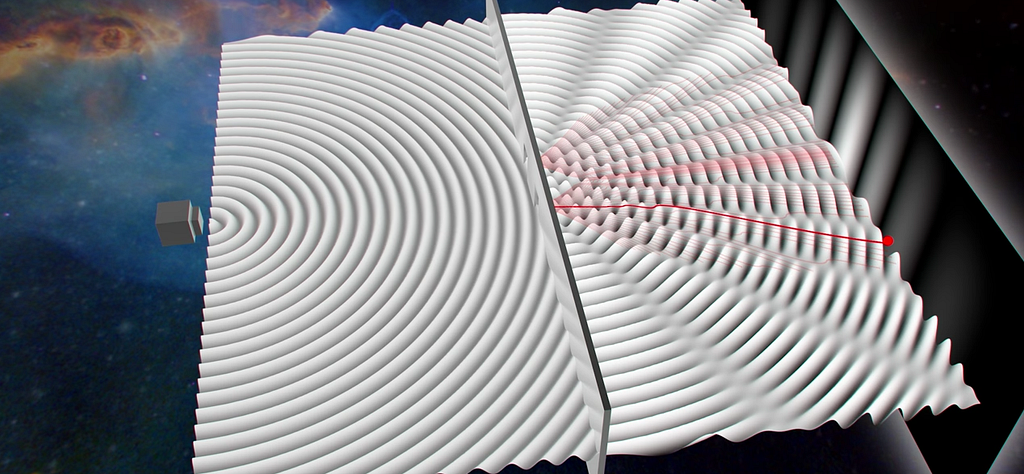
Bohmian Mechanics or the Pilot Wave Theory is probably by far the most intuitive ontological theory of all with quite interesting claims. It’s a quasi-deterministic theory that explains most of the quantum phenomena without ever encountering the measurement problem. The theory claims that all the particles are indeed particle-like forever, moreover, there exists a real wave that determines their bizarre trajectory. The structure of this wave is according to the Schrodinger equation where additionally, there is another equation that governs the motion of the particle within the wave which is called the guiding equation. The guiding equation is the only extra mathematics that the theory requires apart from the existing equations in Quantum mechanics but since it’s derived from the Schrodinger equation itself, it’s considered that this equation existed all along. The interesting side of Bohmian mechanics is that it speaks about special trajectories that particles take because of the waves on which they surf, these unique trajectories (non-crossing rule) are famously called Bohm trajectories and it is exacty the same as a classical chaotic trajectory. Given an initial state of the particle like its position and the velocity, there is a unique trajectory the particle will traverse as per the evolution of the real wave. This means that the particle’s path is actually deterministic in nature where the observed superposition of paths is due to the small perturbations in the initial states of the particles in the collection which leads to large uncorrelated deviations as it traverses through the wave. The theory is reasonable in context to the wave nature that arises just because of the existence of various states a particle can undergo in an experiment. Moreover, the fact that it’s because of the lack of precision readings that it’s impossible to measure the exact state of a particle to figure out its entire trajectory beforehand is what makes Bohmian mechanics very analogous to a classical chaos theory. However, even after eliminating the measurement problem by introducing determinism in the dynamics of the particles, this theory is considered to be a no-go theorem because of the few conflicts and emerging nonlocalities. Unlike other interpretations of QM which are invariant to relativistic effects, Bohmian Mechanics which is based on the absolute time concept is rather incompatible with General Relativity itself because the physical spacetime with an absolute frame from the beginning of time doesn’t fit with the relativity ideologies. Apart from that, the theory also conflicts with the PBR theorem. Indeed the dynamics of the particle is described by the wave but the theory also states that the structure of the wave is itself described by the particles. And since the wavefunction is considered to be a physical wave and globally spread throughout the universe, this suggests that a particle’s state can be affected by any other particle in the universe quite instantaneously which breaks the concept of locality. However, proponents of the theory have used this argument to support the inevitable emergence of entanglement which we can observe in reality and could be derived from the nonlocal potential of Bohmian Mechanics. Moreover, a theory like Bohmian Mechanics which considers the physical existence of the pilot wave in some higher dimension with its corresponding variables non-existent in the standard Hilbert space, is a form of hidden variable theory that suggests why such a simple concept almost analogous to a classical theory can generate nonlocalities.
“If a hidden variable theory is local it will not agree with quantum mechanics, and if it agrees with quantum mechanics it will be non-local”
-John S. Bell