Quantum Theory, from its invention in the early twentieth century, has been successful in predicting the exact results of experiments where classical physics tends to lose its grip. It has since then reinforced mankind’s understanding of the microscopic world and unlocked a new perspective of reality itself. Although its emergence was molded in response to the understanding of unexplained phenomena observed in early particle experiments, the theory itself speaks about how bizarrely unintuitive the reality of any physical system is, when viewed with respect to the quantum states involved. To mathematically assert the framework of Quantum Mechanics (QM), Schrodinger’s wave function denoted by 𝜓 (psi) was formulated which is undoubtedly to date the best mathematical tool to give insights on the quantum states of a particle with a probabilistic approach. The wave function indeed has been rigorously tested along with the experiments and continuous hypothesis testing for decades where it is not only compliant with experimental results but interestingly, the behavior of 𝜓 prior and post-measurement had given birth to a plethora of open-ended interpretations on the nature of objective reality. Perhaps the biggest hurdle in Quantum Mechanics is the so-called measurement problem which questions the inevitable collapse of the wave function to determinism whenever an observation is made. Consequently, a measurement process is such a huge deal that it not only is the additional assumption Quantum Mechanics needs to reproduce results for, but in fact, it’s also completely incompatible with the Schrodinger equation itself. This is because the 𝜓 for a physical quantum system statistically represents its quantum states until a measurement process occurs, after which the 𝜓 distribution apparently collapses/changes to a certain fixed possibility with a 100% probability. Such discontinuity in Schrodinger’s equation and an unexplainable role of measurement in such experiments had baffled the scientific community from the very beginning which led to a century-long brainstorming on various interpretations of what the quantum states described by the 𝜓 exactly speak about the relevant physical system.
“When you change the way you look at things, the things you look at change.” — Max Planck
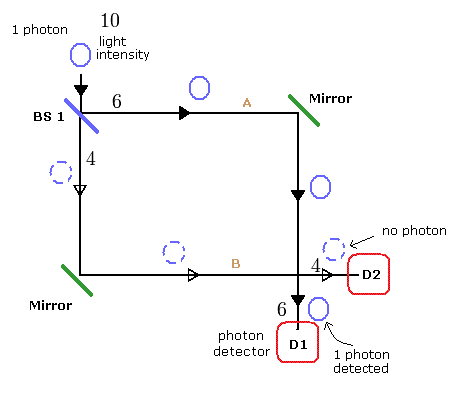
Imagine a setup where we are observing a physical quantum system similar to Wheeler’s delayed choice experiment. The setup would involve a quantum system (obviously!), bunch of possible physical states and particle detectors. So lets imagine the scenario, we initiate our quantum system, let it propagate through the experiment and finally we check for the results. If we as observers choose not to use the detectors, the final results would look like a superposition of all the possible states the quantum system could possibly have, whereas interestingly if we do somehow choose to place detectors (allowing us to read the localized quantum system) after the quantum system has already entered the possible paths but just before measurement, somehow the quantum system’s 𝜓 distribution would collapse into one definite state sanely suggesting that the quantum system, just on the act of measurement transitioned from taking all the paths simultaneously to deciding on one definite path affecting a decision in past! If our current laws of physics is consistent (which probably is), then the above result infers that the observer’s choice of measurement determines how a quantum system evolved in past, independent of when the choice was taken. This suggests strongly that the 𝜓 distribution of the system is highly correlated to the preparation of the setup and the observer’s perspective at any point of time which defeats the absoluteness of any observed event. This would probably make you think, what does the quantum state of a physical quantum system like above, would tell us about the nature of reality? Does the states represented by 𝜓, provides with the factual data about the world or it just represents the state of the observer’s knowledge about the world?
In search for an answer to above questions, multiple interpretations of Quantum Mechanics have been diligently classified into two philosophical classifications by Harrigan and Spekkens (2010) : 𝜓 — Ontic and 𝜓 — Epistemic models.
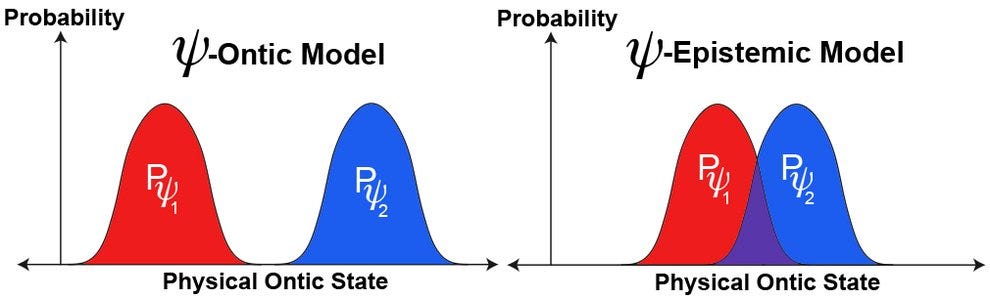
Even though ontological theories like Everrett’s Many-World, Bohmian mechanics, GRW model etc gives an insight on how can we interpret the reality given by the wave function, originally one can also think that there might be some deterministic variables unknown to the current Quantum Theory which would indirectly insinuate about the underlying behaviour of the system. It would then suggest that the measurements doesn’t provide with any factual data about the reality but just the state of the observer’s limited knowledge about it. Such a perspective on QM is called 𝜓 — Epistemic, an interpretation which is highly motivated by the fact that the underlying reality doesn’t depend on the variable settings of environment and that the arising probabilities is purely due to the lack of complete knowledge about the system. Scientists like Einstein and Bohr were the initial pillars to this theory, who believed on the determinacy of the true nature of reality and that the measurement inconsistencies arises due to human minds just not apt enough to comprehend these hidden variables.
However if that’s the case, its interesting to note the behaviour of quantum systems while setting some baseline expectations similar to that of a classical system in order to show determinacy. This is exactly what John Bell did when he stated the assumptions for his infamous Bell’s theorem where he assumed some properties: Locality, Realism and Statistical Independence. In simple words, Locality states that causes and effects can’t move faster than speed of light; the Realism means that there are always some definite properties of a system which are inherent in nature irrespective of any sort of measurement, whereas the statistical independence suggests that the result of an experiment is uncorrelated to the detector/measurement settings. With such assumptions taken into account, he theoretically showed that quantum mechanics is absolutely incompatible with any classical theory (abiding local realism), which indirectly suggest that the quantum world is not locally real. Infact this statement was so huge for the fact that it straightaway disagrees with Einstein’s EPR Paradox, that experiments were conceptualized to test it out, all packing into the category of now known as bell tests. One of these test is to check for the CHSH inequality which could possibly revert the status of QM back to local realism however, all the relevant modern experiments had been consistently violated it so far. A brief description about the same can be found here.

Even though within such a chaotic stance, there are frequent new definition of theories catering to explanations on how an epistemical theory can agree with local causality but still violates the Bell’s inequalities when experimented. One such significant theory is Superdeterminism. Now this theory claims some very bold properties about Quantum Mechanics, but for starters it is kind of a hidden variable theory which is consistent with the experimental results and conspicuously shows the local correlation between the measurement settings and the quantum states of the system. This can be thought intuitively when we remember that modern experiments have proven that for any hidden variable concepts, the bell’s inequality is always violated, hence looking back to the assumption that bases his theorem, a local hidden variable theory such as superdeterminism could violate the inequality only if it violates statistical independence. Lets think about what it leads to, if a theory which is locally real shows a certain dependance of behaviour of quantum particles on the measurement settings, then there has to be some way to explain such dependance for certain experiments where instantaneous 𝜓 collapse leads to non-locality (simple example of entanglement). To think of it there are actually two ways around, first way is to just admit that the quantum particles are the way they depict themselves, completely unpredictable and hence indeed believe that the states truly are not determined at any stage of the experiment until its measured and somehow the collapse can send information faster than the speed of light. Certainly this is exactly what the traditional Copenhagen interpretation is based on. But on the second hand, if locality is to be conserved, there has to be an introduction to absolute determinism in the universe, which speaks that not only all the objects, events evolving in time are predetermined but infact the thought of having a choice in an experiment itself is also fixed. This claim certainly is one kind of a living nightmare and naturally it begs the question whether free will of any sort exists or not? Its initially confusing but this question does have an out of the box answer to it, quite literally. If our universe is a block universe such that every event pertaining to certain space-time location within itself could be absolutely determined by some higher dimensional being outside the influence of spacetime, who can perceive both space and time as a single block, then for them determining everything in past, present and future about our cosmos is as intuitive as pre-deciding the whole journey in their minds. This could be theoretically possible since its known that universe is a 4 dimensional space-time manifold which means everything inside, experiences the flow of time, but that doesn’t mean that the universe itself is moving in time, rather it just contains a time dimension within it. Hence universe being a time-invariant block advocates the concept of superdeterminism even though physicists, humans in general living inside the universe and experiencing flow of time, can have free will to choose possibilities in future.
Its totally understandable if concepts like SuperDeterminism weirdly sounds like claiming some superpositioned jargon about the nature of anything in this universe, but what if the universe completely depends on what the observer has the knowledge about it. A theory which imagines a state not to be any property describing about the system but its the observer’s state about the system, hence the probabilities involved are just a reflection to an observer’s beliefs but most importantly this abandons the objective nature of reality, for which the Quantum Mechanics was built in the first place. This theory is not called super-probabilistic but rather its called Quantum Bayesianism or QBism which is a recent development of early 21st Century. As the name insinuates, probability has a big role in it, where whenever a measurement is taken, its considered not as probabilities collapsing but actually the observer updating their belief about the system, just like how Bayesian probability works. With such a simple perspective, the wavefunction collapse sounds perfectly fine because now the measurement just speaks about an information depending on the observer and doesn’t even affect the system anyhow, hence problems like non-locality and non-causality doesn’t arise with the collapse. Its pretty evident how it quickly solves all the puzzles we have been talking about, but if noticed carefully it doesn’t talk anything about an objective reality in-fact it blatantly advocates the subjective nature of a system. Observers are the center piece to this interpretation where actually 𝜓 doesn’t talk about the system but it has been all about the observers. Each observer’s baseline reality is different and hence the measured 𝜓 for the universe would individually update their own beliefs coherently independent of other observer’s update. QBism is pretty much supported by many minds because of how it solves the measurement problem but, fairly judging it, even though its an epistemical idea, it just completely ignores an underlying reality independent of anything in the universe which is the core belief of all the other models within the subclass.

𝜓 — Epistemic models have certainly been in a chaotic regime from the time it was first coined, but even though these models have emerged in order to reason the age old inevitable inconsistencies in the wave function, efforts on new perspectives to QM and sufficing the experimental datas with constantly updating physics had just led to a deeper understanding about our own knowledge about the universe. However, there are other group of experts whose interpretation is rather more practical where the physical reality explained by the wave function is literally considered as the true nature of the universe. The emergence of such theories have been, in past few decades, supported by various experiments and paperwork, which has turned the winds towards the Ontological models.