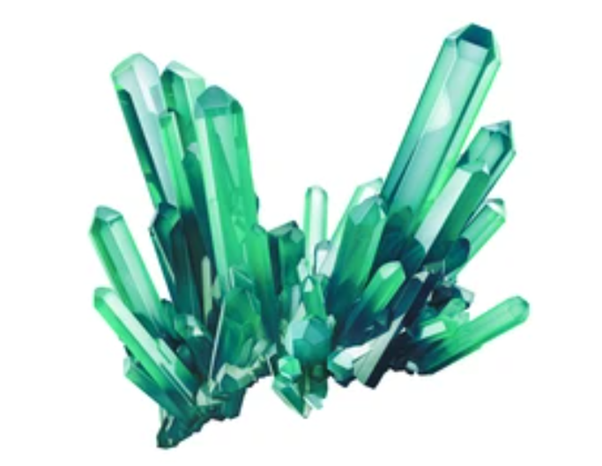
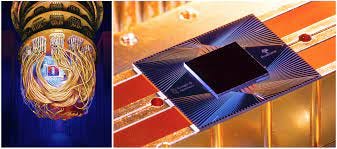
A recent discovery made by the team of researchers using Google’s Quantum computer has introduced a potential candidate for a new phase of matter only been heard in stories and movies before. The first ever discrete Quantum Time Crystal stabilized as a result of many-body localization (MBL) process was created and observed inside the quantum computer, Sycamore, last November 2021 and it behaved exactly as originally theorized back in 2012, by Nobel laureate Frank Wilczek.
Analogous to an ordinary crystal lattice, which has a certain arrangement of atoms in repeating pattern with respect to space, in order to attain the lowest energy state possible , a theoretical time crystal naturally repeats and flips between its states periodically with time without consuming any form of energy, as a natural characteristic of repeating pattern but in time instead of space. Indeed, the time crystal created inside Sycamore did show this unique property where it flipped from one state to another with regular time interval without any input source. The team used 20 superconductive qubit system where each qubit was randomly pointing to one of its states ( here states represent the quantum spins ), with all of them placed close enough to interact with each other. This arrangement acts as a time crystal when a driving external stimulus like laser was passed through it. Interestingly, though laser was used as an external stimulus, the system didn’t consume any kind of energy at all, and strangely the behavior of time crystal was unexpected when the frequency of flipping between states was different than the frequency of laser beam being used, indicating this intrinsic property of time crystals.
Though time crystals were first theorized in 2012, it was first identified and confirmed in 2016 during an experiment on 14 trapped Ytterbium ions out of their mutual coulomb attraction, where an alternating sequence of laser pulses were used to drive the flipping of their spins. The observations made were crystal clear indicating the oscillatory time evolution of spin which was exactly twice the period of laser been used. In fact, these spin oscillations persisted even when changing the parameters of the laser. This was the first experimental evidence of a spontaneous violation to long known time-translational symmetry which was thought to be obeyed by all the matter. Time translational symmetry states simply that irrespective of time, the laws of physics would be same at any instance of time anywhere in space. Conservation laws like conservation of energy, are the direct consequences of time symmetry. And therefore, there were a lot of past debate on considering time crystals violating some of the fundamental laws, which should make it impossible to even exist. Does switching states without consuming energy indefinitely, makes it a perpetual motion system? or does it violate the conservation of energy?
A time crystal is not a perpetual motion system. To think of it, it is a quantum system which is stimulated by an energy source but doesn’t consume nor produce energy or work of any sort, because a time crystal is already in its lowest energy state possible. Also, unlike perpetual motion systems, time crystals in a finite amount of time would never reach in equilibrium, because to break time symmetry, it should be a non-equilibrium matter (switching between dynamic states though it might jump past its stable and unstable equilibrium states ).
While it has a natural behavior of continuously flipping from one state to another, it doesn’t really contribute to the term entropy, its overall energy is contained indefinitely by existing in dynamic states where laws of thermodynamics don’t fit well. In other words, thermodynamic laws explain a long-term process but not the shorter constituent instances of it. And so, the overall time crystal process results into net zero entropy, not violating the laws of thermodynamics but still acts as if it breaks it.

If we think from a quantum approach, experimental time crystals ever made, constitutes of only few countable number of atoms, ions, or qubits, so if we observe any property of this system then quantum effects will definitely play a crucial role in it. A many-body localization system and a macroscopic object is very different in context to behavior it exhibits to a local observer. Time crystal is a many-body localization system which mean that it is made of few number of particles each of them interacting with each other and overall truly isolated from the external environment. Because of this isolated system made of only few particles, the overall energy of this system will greatly depend on any of the particle’s relative motions about rest of them, changing in terms of electromagnetic interaction energy as well as its kinetic energy. This restricts the arrangement and states of MBL systems a lot because of conservation of energy. More to it when governing quantum equations like Schrodinger equation doesn’t allow any quantum particle to be stationary in any sense with respect to time, MBL’s states naturally evolves while respecting conservation of energy, thus according to quantum statistical mechanics, evolves towards the thermal equilibrium. But it never reaches thermal equilibrium for finite time, violating eigenstate thermalization hypothesis and instead, its dynamic states are close to its initial condition or initial arrangement of states. And that’s why, this makes time crystals to be in stable non-equilibrium states which are also called as Floquet states. The moment, they can interact with external environment, energy can be exchanged and now there can be much greater number of possible configurations for the particles in the system, thus reaching thermal equilibrium and losing its temporal property.
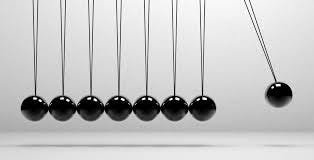
Imagine a simple pendulum in gravitational influence, where the bob oscillates back and forth about its stable equilibrium state with respect to time, if this pendulum is continuously fed by some driving oscillation, then the bob will always avoid being in its stable ground state equilibrium and would be able to reach other non-equilibrium states even as a perfect inverted bob (stable non-equilibrium state) if, of course, driving oscillation is sufficient. But the moment this driving force is gone, effects like hinge friction, loses energy to its surroundings which makes it ultimately reach its stable equilibrium.
A time crystal built inside a quantum computer had already indicated the true power of computation, a quantum computer has over a classical computer, as well as have cleared the direction of research on time crystals for its future applications of its initial state memory ability which might be useful as a quantum memory or quantum information processing for a quantum computer. Ever since this experiment, the research is extensively going on to combine multiple time crystals or creating one single huge time crystal to observe the limits and potential they carry for future applications. Recently theorist at university of Melbourne built a time crystal made of 57 qubits inside IBM’s quantum computer which is by far the biggest time crystal created, though it lasted for only 50 short cycles.
Whereas an attempt made by a team in Aalto university, demonstrated interaction between two time crystals, each made up of trillions of magnons, which is collective excitation of electron’s spin, acting as an energy wave. These time crystals were made in an environment of Helium-3 isotope cooled closed to absolute zero, such that it became a B-phase superfluid. With this medium, time crystals were frozen to the point when all the atoms stop moving, reaching their lowest energy state, overlapping, and producing one high density cloud of atoms as a matter wave. This led the time crystals to touch each other allowing to exchange their magnons resulting into one single system of two dynamic states, thus acting as a single time crystal. Though this phenomenon was observed for quite a time, to maintain and control this specific environment for long enough is rather the most challenging part where, researchers are further looking into further developments.
In future, what if we can make time crystals of macroscopic scale and can be used as an ordinary matter always getting restored to its previous state, whenever triggered. But as of now its limits seems to be within quantum realm.